

If your progress stalls after a strong start, you’re not broken—you’re meeting metabolic adaptation. In plain terms, your body gets more efficient as you lose weight, so it burns fewer calories than you’d expect. Understanding metabolic adaptation weight loss helps you adjust your plan—without crash diets or burnout.
Quick take: A smaller body burns fewer calories, and built-in “defenses” (lower resting energy use, less spontaneous movement, stronger hunger signals) can nudge you to regain. Smart nutrition, resistance training, and daily activity can help counter these shifts, sustainably. PMC+1
Read next: Calorie Deficit 101: A Simple, Safe Starter Guide.
Metabolic Adaptation Weight Loss: What It Is
Metabolic adaptation (often called adaptive thermogenesis) is the body’s coordinated response to weight loss: resting energy expenditure dips beyond what you’d predict from a smaller body size, non-exercise movement tends to fall, and appetite signals ramp up. These changes may help your body defend its previous weight and make regain more likely if you return to old habits. PMC
This effect can persist for months—and sometimes years—after large, rapid weight loss. A well-known follow-up of “Biggest Loser” participants found substantial regain and a lingering reduction in resting metabolic rate years later, even after accounting for body size. PubMed+1
That said, not all research agrees on the magnitude of metabolic adaptation at rest. Some controlled analyses suggest the effect at the level of RMR is relatively small when people are weight-stable, and it doesn’t always predict regain. The practical takeaway: adaptation exists—but behavior (diet quality, activity, sleep/stress) still drives outcomes you can control. PubMed
Read next: Morning Habits That Boost Metabolism: 7 Science-Backed Tips.
Why Weight Loss Often Slows After 3–8 Weeks
- You weigh less. A smaller body simply requires fewer calories to move and maintain.
- Adaptive thermogenesis. Resting energy use may dip more than expected for your new size, and appetite signals increase to defend weight. PMC
- NEAT creeps down. Non-exercise activity thermogenesis—all the walking, standing, fidgeting you do—often falls subconsciously during a diet. Wiley Online Library+1
- Behavioral shifts. Calorie restriction can reduce physical activity in real-world settings, further shrinking your burn. PubMed
- Aggressive deficits backfire. Big cuts crank up fatigue and hunger, making consistency harder; mainstream guidance favors gradual, sustainable change. CDC+1
Signs You May Be Experiencing Metabolic Adaptation
- Persistent plateau despite adherence for 2–3+ weeks
- Lower energy / chilly feeling, workouts feel harder
- Appetite spikes, especially at night
- Daily steps trending down (check your tracker)
- Large early loss, then stall after the first month
Note: Rule out other factors too—hidden calories, weekend overshoots, inconsistent tracking, poor sleep, stress, medications, or health conditions.
Read next: Sleep and Weight Loss: The Hidden Link + 7-Day Wind-Down Routine.
What Helps (Without Going Extreme)
1) Set a modest, sustainable calorie deficit
Chasing 1–2 lb/week is a common, sustainable target for many adults. That usually means trimming roughly ~500 kcal/day, but the right number varies by body size, activity, meds, and health status. Avoid crash diets. CDC+1
<u>How to apply:</u> Re-estimate your TDEE every 6–8 weeks as you get lighter; adjust intake or activity by ~150–300 kcal at a time, then reassess for 2–3 weeks.
Citation note: Some studies argue resting metabolic adaptation is modest at weight stability. Either way, gradual, behavior-based tactics remain effective. PubMed
2) Prioritize protein to protect lean mass
During a deficit, higher protein can help preserve fat-free mass and support satiety. Trials suggest intakes above the RDA (e.g., around 1.2–1.6 g/kg/day for many) may help protect lean mass while losing fat. Distribute protein across meals (e.g., ~25–35g each). PubMed+1
<u>How to apply:</u> Anchor each meal with a quality protein (eggs, poultry/fish, Greek yogurt/skyr, tofu/tempeh, legumes, whey/soy isolate).
3) Lift 2–4 days/week (and keep it simple)
Resistance training helps maintain (or build) lean mass so your total daily burn doesn’t drop as sharply when you diet. Think full-body 2–4×/week, 5–8 basic movements (squat/hinge/push/pull/carry), progressive loads you can recover from.
How to apply: Track reps and loads; add small increments weekly if recovery and form allow. Pair with a brisk walking base.
4) Build back your NEAT (Non-Exercise Activity Thermogenesis)
NEAT can vary by hundreds of calories/day between individuals and often declines during dieting. Walking more, standing, fidgeting, and micro-bouts of movement throughout the day can meaningfully raise your total burn—without crushing workouts. Wiley Online Library+1
How to apply:
- Set a step floor (e.g., 7–10k) and protect it even on rest days.
- Insert 5–10 minute “movement snacks” after meals and long sits.
- Tidy, garden, or take calls while walking—small habits compound.
In long-term follow-ups, more physical activity was linked with less weight regain after large losses. Semantic Scholar
5) Sleep & stress hygiene
Short sleep and chronic stress can push appetite up and energy out down, making adherence harder. Mainstream guidance for healthy weight loss highlights sleep and stress management alongside diet and activity. Aim for consistent 7–9 hours and a simple nightly wind-down. CDC
How to apply: 60–90 minutes pre-bed: dim lights, shut down alerts, light stretch, warm shower, cool, dark room.
6) Use “maintenance phases” strategically
Taking brief maintenance breaks (eating at approximate maintenance for 1–3 weeks) may help psychologically, support training quality, and stabilize routines. Evidence on “diet breaks/refeeds” for reversing adaptation is mixed, so treat these as adherence tools rather than magic fixes. Wiley Online Library
7) Mind your timeline (and expectations)
Fast losses often rebound. Slower, steadier approaches plus durable habits—protein-forward meals, resistance training, NEAT—tend to stick. If progress stalls despite adherence for 6+ weeks, check meds/conditions with a clinician and consider multidisciplinary support.
Read next: How Gut Health Affects Weight Loss (And How to Fix It).
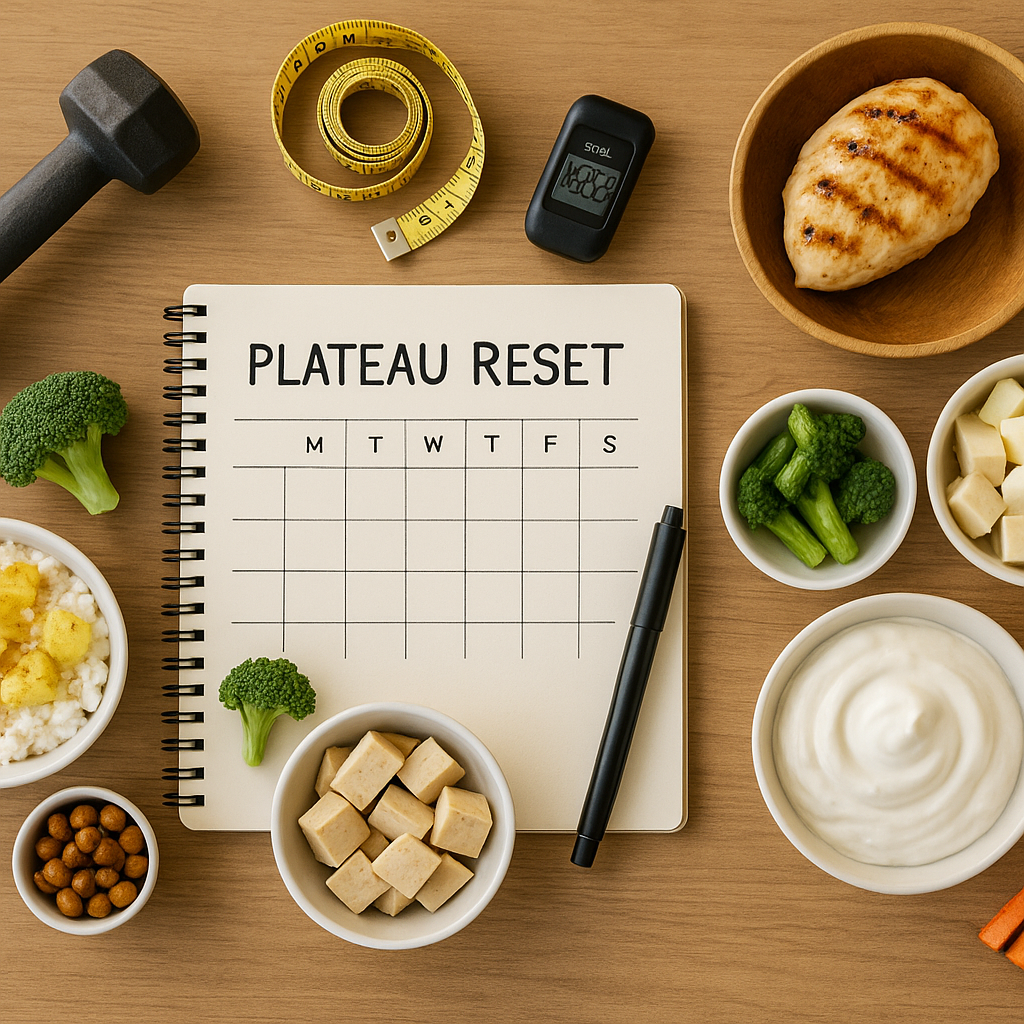
7-Day “Reset” Blueprint (Template You Can Reuse)
Goal: Ease off the plateau by restoring NEAT, protecting muscle, and improving adherence—without slashing calories.
Daily anchors (copy/paste checklist):
- Protein floor: ~1.2–1.6 g/kg/day, spread across 3–4 meals
- Produce: 2+ cups non-starchy veg + 1–2 fruits
- Movement: 8–10k steps + 2–3× lifting (full-body)
- Sleep: 7–9 hours; consistent bed/wake
- Stress: 10 minutes breathwork/walk/journaling
- Drinks: Mostly water/unsweet tea; limit alcohol
- Energy tweak: If stuck ≥2 weeks, adjust by ~150–200 kcal/day and re-check after 14–21 days
Mon/Wed/Fri (Full-Body A/B):
Squat or leg press · Hip hinge (RDL) · Horizontal push (press) · Horizontal pull (row) · Vertical pull (pulldown) · Core carry or plank (2–3 sets each, RPE 7–8)
Tue/Thu/Sat (NEAT focus):
AM 10–20 min brisk walk + 3–4 movement snacks (5–10 min) + PM 20–30 min stroll
Meal pattern example (protein-forward):
- Breakfast (~30g): Eggs + Greek yogurt or tofu + oats
- Lunch (~35g): Chicken/tempeh + greens + beans + olive oil spray
- Snack (~20g): Skyr/cottage cheese or soy shake
- Dinner (~35g): Fish/legume chili + veggies + whole-grain/starchy veg
Troubleshooting: What If the Scale Won’t Move?
- Audit weekends. Many plateaus are Thursday–Sunday problems. Track “off” hours honestly.
- Tighten portions on energy-dense extras. Measured oils, nuts, cheese, sweets.
- Swap snacks for protein + fruit/veg. Helps satiety with fewer calories.
- Re-check steps. If you’re averaging 5k, push 8k for 2 weeks.
- Adjust in small bites. −150 to −300 kcal/day or +1–2k steps/day, then reassess.
FAQ
Is metabolic adaptation permanent?
It can last for months and may linger after large, rapid losses—but habits still matter most for long-term outcomes. Many maintainers succeed by staying active, prioritizing protein, training, and protecting sleep. PubMed+1
Should I eat even less when I stall?
Sometimes a small tweak works. Often, restoring NEAT, tightening portions, or improving sleep/stress is enough. If you’ve already cut hard, consider a brief maintenance phase to reset adherence. CDC
Do I need cardio every day?
You don’t need heroic workouts. A mix of resistance training (muscle retention) and plenty of NEAT (daily movement) supports sustainable loss. Wiley Online Library
Will high protein “speed up” my metabolism?
Protein won’t “rev” metabolism in a magical way, but it may help preserve lean mass and keep you fuller so a deficit is easier to maintain. PubMed
References
- Rosenbaum M, Leibel RL. Adaptive thermogenesis in humans. Int J Obes (Lond). 2010. PMC
- Fothergill E, Hall KD, et al. Persistent metabolic adaptation 6 years after “The Biggest Loser”. Obesity. 2016. PubMed+1
- Hall KD. Metabolic Adaptations to Weight Loss. Obesity. 2018. Wiley Online Library
- Pasiakos SM, et al. High-protein diets during weight loss protect fat-free mass. Am J Clin Nutr. 2013. PubMed
- Oikawa SY, et al. Higher protein intake (≈1.6 g/kg) preserves lean mass during energy restriction. Am J Clin Nutr. 2018. AJCN
- Levine JA. Non-exercise activity thermogenesis (NEAT). J Intern Med. 2007; plus overview papers. Wiley Online Library+1
- CDC. Steps for Losing Weight (sleep & stress included). 2024. CDC
- NIH News in Health. Healthy Weight Control (≈500 kcal/day ≈ 1 lb/week). 2022. NIH News in Health
- Martins C, et al. Metabolic adaptation is not a major barrier… Am J Clin Nutr. 2020. PubMed
Medical Disclaimer: This content is for educational purposes and does not replace personalized medical advice.