Looking for a TDEE calculator you can trust? This guide explains exactly how Total Daily Energy Expenditure works, walks you through the formulas step by step, and shows you how to turn your number into real-world meal targets—without crash dieting. You’ll also get a free, copy-ready calculator framework plus examples for quick checks.
Skim this section first, then use the step-by-step to run your numbers in under 2 minutes.
Read next: Calorie Deficit 101: A Simple, Safe Starter Guide.
TDEE Calculator: What It Is & Why It Matters
TDEE (Total Daily Energy Expenditure) is the estimated number of calories you burn in a day from:
- BMR/RMR (your baseline burn at rest),
- movement (steps, chores, fidgeting/NEAT), and
- exercise (workouts).
Knowing TDEE helps you:
- Maintain your weight (eat ≈ TDEE).
- Lose weight (eat below TDEE in a modest deficit).
- Gain weight/muscle (eat above TDEE in a measured surplus).
<u>Reality check:</u> TDEE is a best estimate, not an absolute truth. Use it as your starting point, then calibrate with the scale, waist, and how you feel over 2–3 weeks.
How a TDEE calculator works (BMR → Activity → TDEE)
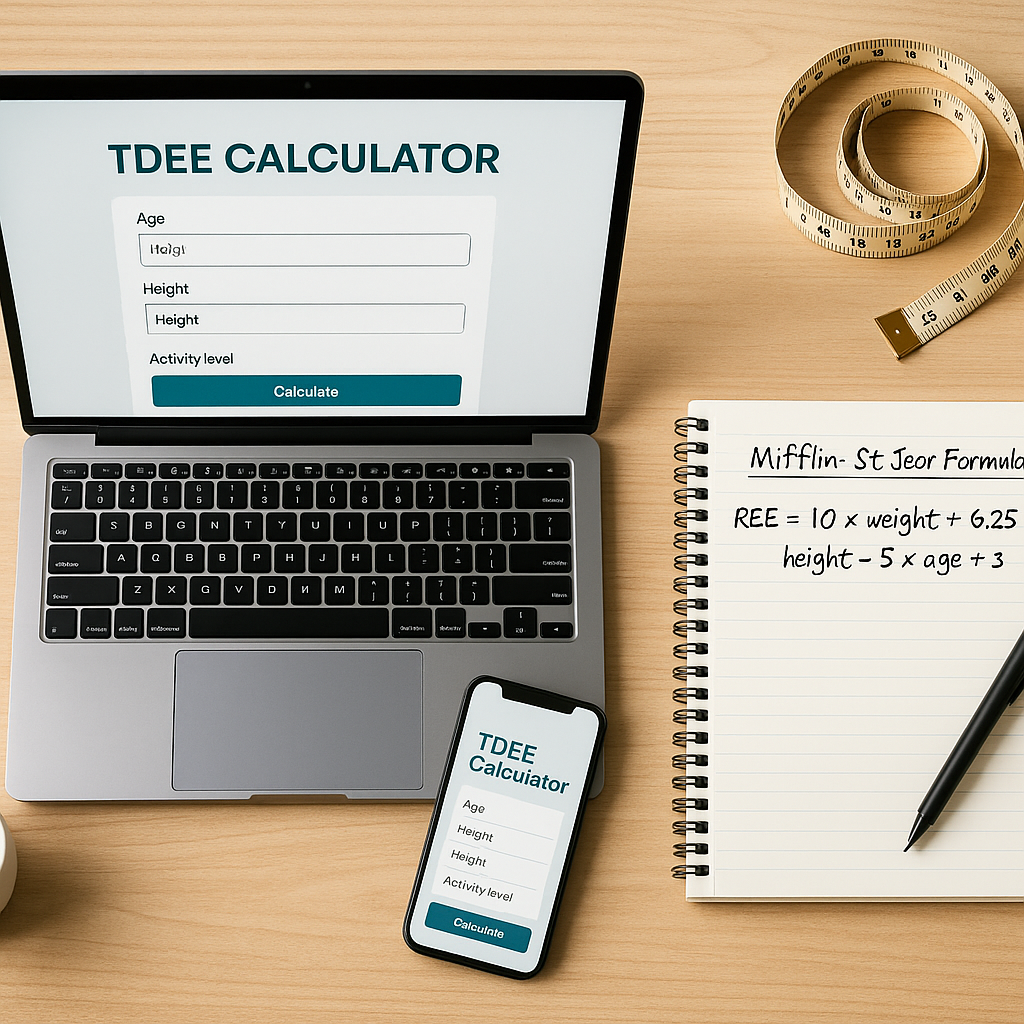
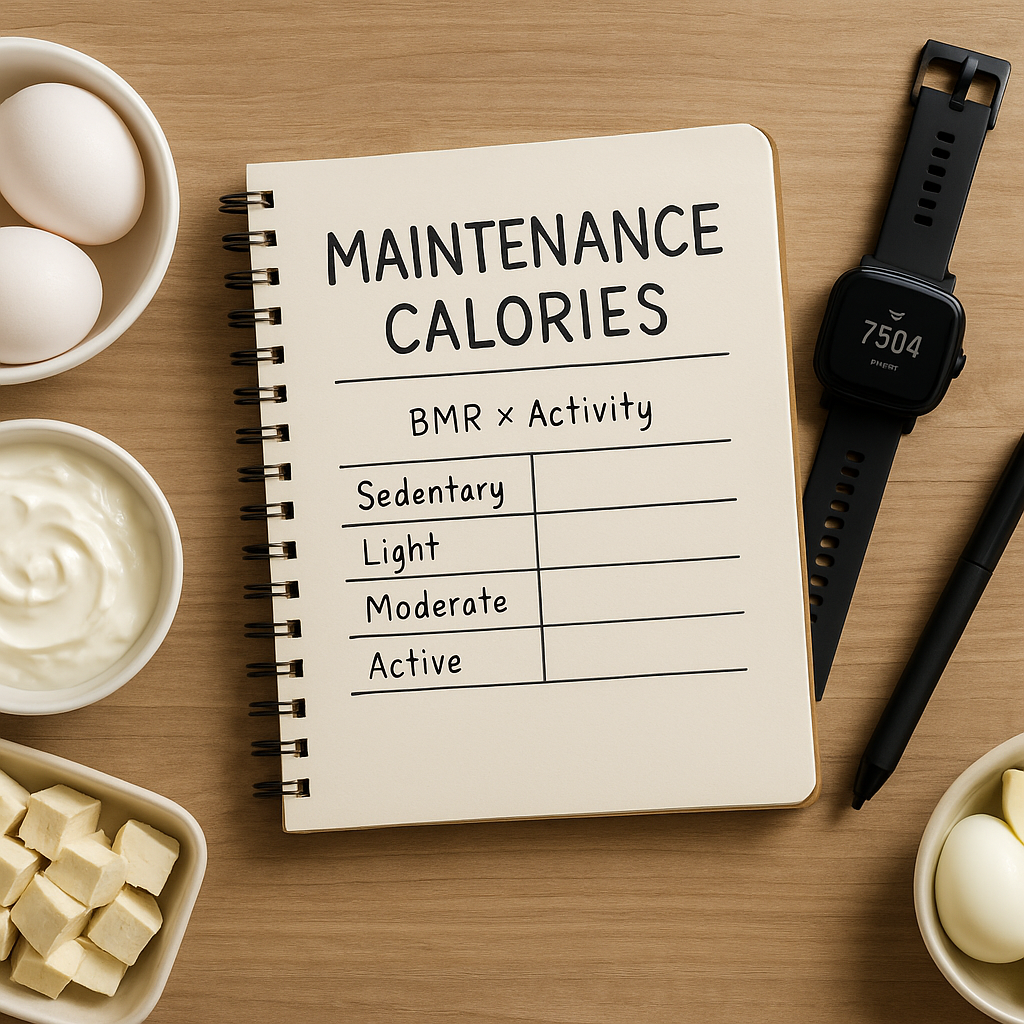
A solid TDEE calculator estimates your BMR first (how much you burn at rest), then multiplies by an activity factor to include movement and exercise.
Step 1 — Estimate BMR (two common formulas)
- Mifflin–St Jeor (works well for most adults)
- Men: BMR = 10×weight(kg) + 6.25×height(cm) − 5×age(y) + 5
- Women: BMR = 10×weight(kg) + 6.25×height(cm) − 5×age(y) − 161
- Katch–McArdle (useful if you know body-fat %)
- BMR = 370 + 21.6 × FFM(kg), where FFM = fat-free mass.
Tip: If you’re unsure of body-fat %, stick with Mifflin–St Jeor and good activity logging.
Step 2 — Choose an activity factor (typical ranges)
- 1.20 — Sedentary: desk job, minimal intentional movement
- 1.35 — Lightly active: 6–8k steps/day or 1–3 light workouts/week
- 1.50 — Moderately active: 8–12k steps/day or 3–5 workouts/week
- 1.70 — Very active: manual work or 5–7 hard sessions/week
- 1.90 — Athlete/exceptional: two-a-days, heavy labor, very high NEAT
Step 3 — Multiply
TDEE = BMR × Activity Factor
Accuracy improves when your activity factor reflects steps + training honestly. Err slightly low if you sit most of the day.
Read next: Morning Habits That Boost Metabolism: 7 Science-Backed Tips.
How to use this free TDEE calculator (step by step)
- Collect inputs: sex, age, height, weight, optional body-fat %, typical steps, weekly workouts.
- Pick formula: use Mifflin–St Jeor by default; use Katch–McArdle if you know body-fat % reasonably well.
- Pick activity factor: use the guide above; log one typical week of steps to choose better.
- Calculate TDEE: BMR × activity factor.
- Set goal calories:
- Maintain: ≈ TDEE
- Lose fat: TDEE − 10–20% (start modest)
- Gain muscle: TDEE + 5–15% (keep protein high)
- Run a 2–3 week test: track weight (or waist/fit), energy, hunger, and adjust by ~150–200 kcal if needed.
Safety first: If you have a medical condition, are pregnant/postpartum, or take medications that affect weight/appetite, talk to your clinician before changing your diet.
Example calculations (so you see the math)
Note: These are illustrative; your numbers will differ.
Example A (Mifflin–St Jeor):
- Woman, 34, 165 cm, 72 kg, desk job + 3 light workouts
- BMR ≈ 10×72 + 6.25×165 − 5×34 − 161 = 720 + 1031 − 170 − 161 ≈ 1,420 kcal
- Activity factor (light) = 1.35 → TDEE ≈ 1,420 × 1.35 = 1,917 kcal
- Fat-loss target (−15%): ~1,630 kcal/day to start
Example B (Katch–McArdle):
- Man, 41, 180 cm, 88 kg, ~20% body fat, 10k steps + 4 lifts/week
- FFM = 88 × (1 − 0.20) = 70.4 kg → BMR = 370 + 21.6×70.4 ≈ 1,889 kcal
- Activity factor (moderate) = 1.50 → TDEE ≈ 2,833 kcal
- Muscle-gain target (+10%): ~3,115 kcal/day to start
Track for 14–21 days. If average weekly weight change isn’t trending toward your goal, nudge by 150–200 kcal and reassess.
Turning TDEE into a meal plan (simple math you’ll actually use)
Once you have goal calories (e.g., 1,800 kcal), split them into 3–4 anchors:
- Protein: ~1.2–1.6 g/kg/day (helps preserve lean mass while losing fat)
- Fat: ~0.6–1.0 g/kg/day (hormones, absorption, satiety)
- Carbs: fill the remaining calories (fuel training, fiber)
Quick template (~1,800 kcal cut):
- Protein: 120–140 g (≈ 480–560 kcal)
- Fat: 55–70 g (≈ 500–630 kcal)
- Carbs: ≈ 160–220 g (balance of calories), bias toward high-fiber options
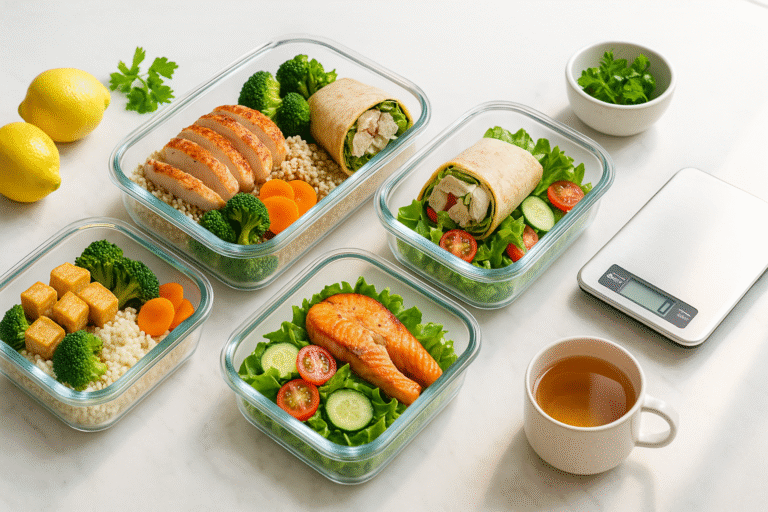
Plug-and-play meals:
- Breakfast: ~30 g protein (eggs + skyr/tofu + oats) — see 30g Protein Breakfast Ideas.
- Lunch: ~35–40 g protein (chicken/tempeh + grains + veg).
- Dinner: ~35–45 g protein — see 500-Calorie Dinners: 30 Balanced, Protein-Forward Recipes.
- Snack(s): ~15–25 g protein (cottage cheese/soy shake/edamame).
Common mistakes (and easy fixes)
- Over-estimating activity. If you sit most of the day, pick sedentary/light even with a 45-min workout.
- Fix: Use your step average to choose the factor honestly.
- Under-counting oils, dressings, extras. Teaspoons matter.
- Fix: Measure oils, nuts, cheese, and sauces for 1–2 weeks.
- Aggressive deficits. Big cuts can spike hunger, hurt training, and stall adherence.
- Fix: Start with 10–15% below TDEE; adjust slowly.
- Never recalculating. As you get lighter, maintenance drops.
- Fix: Re-estimate every 4–8 weeks or per 5–10 lb lost.
- Ignoring NEAT. Steps/standing vary by hundreds of kcal/day.
- Fix: Protect a step floor (e.g., 7–10k). Add movement snacks after meals.
- Chasing “perfect” formulas. The best formula is one you’ll calibrate.
- Fix: Use a solid baseline (Mifflin or Katch), then adjust via data.
- Poor sleep/stress. Can raise appetite and drain energy.
- Fix: Simple wind-down routine and consistent 7–9 hours.
Read next: Sleep and Weight Loss: The Hidden Link + 7-Day Wind-Down Routine.
Advanced notes (when to use Katch–McArdle or custom factors)
- Higher body-fat %: Mifflin can over-estimate slightly; Katch (with a decent BF% estimate) may track better.
- Very high NEAT jobs: If you’re on your feet all day (servers, nurses, warehouse), 1.70 can be realistic—even without formal workouts.
- Wearables: Smartwatches are useful for trends, but over-report calories for many people. Always calibrate with 2–3 weeks of outcomes.
- Plateaus: Expect some metabolic adaptation; tighten logging, keep steps up, consider a brief maintenance phase, then resume.
7-Day “Find-Your-Maintenance” plan (practical & repeatable)
Goal: Confirm your TDEE within ~100–200 kcal by combining math + real-world data.
Daily anchors (7 days):
- Eat your target calories (maintain/cut/gain).
- Hit protein (~1.2–1.6 g/kg).
- Steps: 8–10k (or hold steady at your true baseline).
- Train 2–3× (full-body), keep sessions consistent.
- Sleep 7–9 h; minimize alcohol.
Track: morning weight (3-day rolling average), waist, energy, hunger.
- If weight is steady ±0.2%/week → you’re near maintenance.
- If losing >0.7% body weight/week, consider +100–150 kcal or add carbs around training.
- If losing <0.2%/week and you want fat loss, try −150–200 kcal or add 1–2k steps/day.
FAQs
Is TDEE the same as maintenance?
Close. Maintenance ≈ your current TDEE, but it shifts as weight and activity change.
Which formula is “best”?
There’s no universal winner. Mifflin–St Jeor works well for most; Katch–McArdle is useful if you know body-fat %.
Do I eat back exercise calories?
If your activity factor already includes your usual training, don’t double-count. If a session is unusually long/intense, a small post-workout carb add-on can help recovery.
How often should I recalc?
Every 4–8 weeks or after notable routine changes (new job shift, training phase, big step-count shifts).
Will protein “boost” TDEE?
Higher protein won’t magically speed metabolism, but it may help preserve lean mass and make a deficit easier to sustain.
References
- Mifflin MD, et al. A new predictive equation for resting energy expenditure. Am J Clin Nutr. 1990.
- Katch VL, McArdle WD. Nutrition, Weight Control, and Exercise (fat-free mass–based BMR).
- USDA & HHS. Dietary Guidelines for Americans, 2020–2025.
- NIDDK/NIH. Healthy Weight Management educational resources.
Medical Disclaimer: This content is for educational purposes and does not replace personalized medical advice.